
How Virtual Assistants Can Help Build Your Sales Pipeline
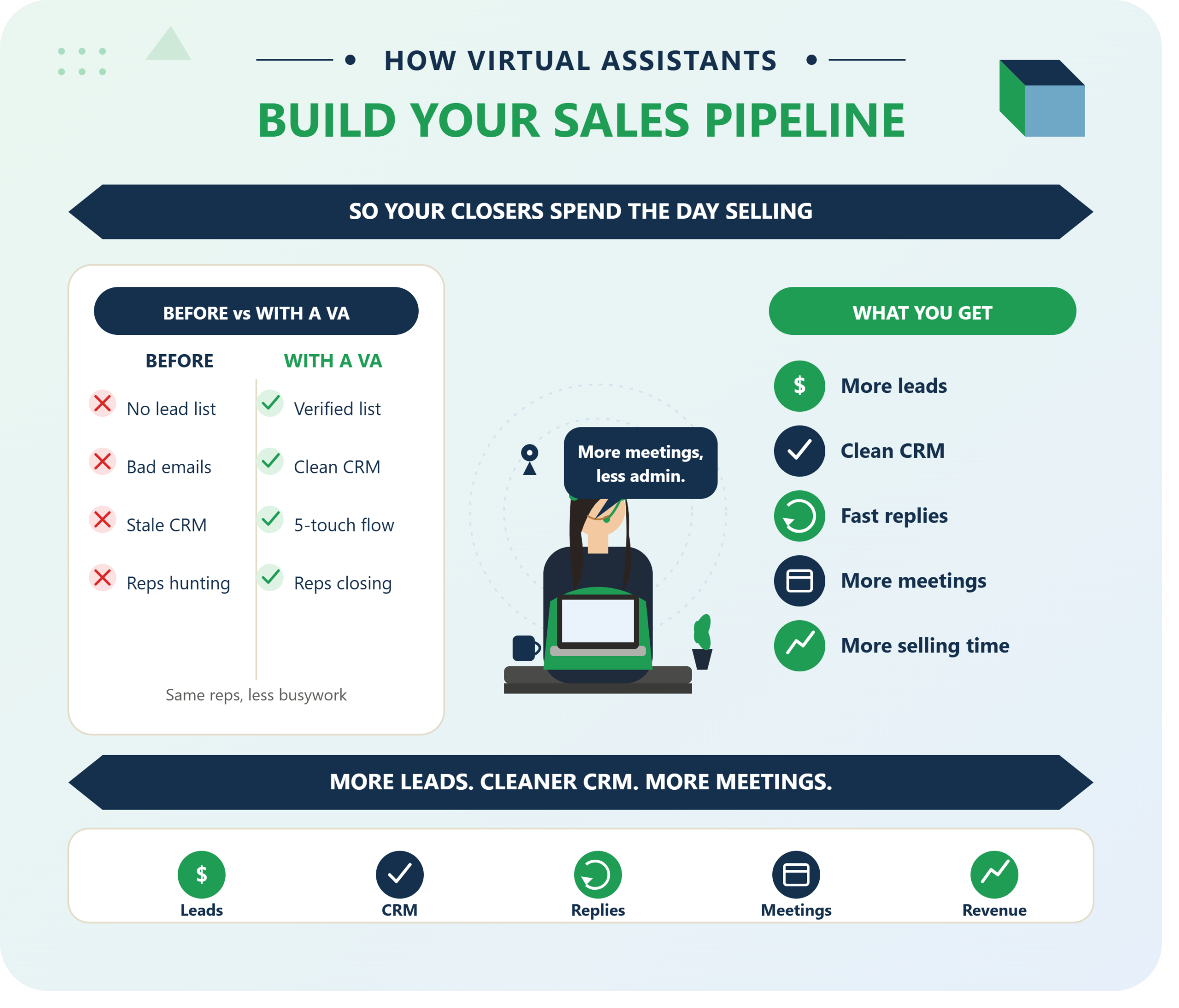
Ask any salesperson where their week went and the answer is rarely “selling”. It went to building lists, verifying emails, updating records nobody reads, writing the fourth follow up to someone who already said no, and rescheduling a demo three times. Research on sales productivity keeps landing in the same uncomfortable place: closers spend a minority of their time actually talking to buyers. That is not a motivation problem. It is a workload problem, and it is fixable without hiring another commission carrying rep. A virtual assistant for sales takes the groundwork, so the people who close spend their hours in conversations instead of spreadsheets.
A virtual sales assistant builds and verifies prospect lists, keeps your CRM accurate, handles first touch outreach, books meetings and runs follow up sequences, so your sales team focuses on closing.
Why Pipelines Stall in the First Place
Most pipelines do not fail at the close. They fail earlier, in three quiet places.
The first is volume. Not enough qualified prospects enter the top, so the team lives on whatever inbound arrives that month. The second is data. Wrong contacts, dead emails, duplicate records and stale notes make outreach bounce and forecasting guesswork. The third is follow up. A large share of deals need five or more touches, yet most reps stop after two because chasing feels unproductive compared with a live call.
All three problems are process work. None of them requires a senior closer. That is exactly why they suit delegation.
Building the Top of Your Pipeline
A lead generation virtual assistant starts with your ideal customer definition, then goes and finds those companies one by one. That means identifying businesses matching your criteria on size, industry, location and buying signals, finding the right decision maker rather than a generic info address, verifying the email and phone, and recording where the contact came from.
Good list building is slower than people expect and worth more than they realise. A list of two hundred verified, well targeted contacts outperforms two thousand scraped ones every time, both in reply rate and in sender reputation. Assistants can also track trigger events, such as a company opening a new location, posting relevant job adverts or announcing funding, which gives your opener something real to reference.
Deeper background work sits with a research assistant: competitor pricing, market sizing, tender listings and account briefs your rep reads five minutes before the call.
Keeping the CRM Honest
A pipeline you cannot trust is a pipeline you cannot forecast. Most CRMs decay quickly because updating them is the last thing a rep does at 6 pm.
A CRM enrichment assistant fixes and then maintains it. They merge duplicates, complete missing fields, correct job titles after people move roles, log activity from email and calls, move stalled deals to the right stage, and flag opportunities that have gone quiet. They also clean out contacts who bounced, which protects your domain reputation more than any tool will.
The effect shows up in management, not just admin. When stages are accurate, you can see whether the problem this quarter is lead volume, conversion, or deal size. Without that, every pipeline review is opinion. If your records are badly out of date, a one-off data entry project usually comes first, then ongoing upkeep.
Can a Virtual Assistant Actually Do Outreach?
Yes, within limits that are worth setting deliberately.
Assistants handle first touch outreach well: sending sequences from your templates, personalising the opening line using research they gathered, replying to routine questions, and booking meetings straight into your rep’s calendar. They manage the follow-up cadence that reps abandon, which is where a surprising number of deals come back to life. They also handle LinkedIn connection requests and message threads where your tone is documented.
What they should not do is negotiate, quote outside a published structure, or handle a technical discovery call that needs product depth. The line is simple. Assistants create and qualify conversations. Your closers run them.
Set this up properly and the rep’s morning changes shape. Instead of prospecting, they open a calendar with four booked calls and account notes already attached.
Following Up Without Being Annoying
Follow up is where most pipelines leak, and where a virtual sales assistant earns their hours quietly.
A workable cadence looks like this. Touch one is the initial message. Touch two arrives three days later with a different angle rather than a repeat. Touch three offers something useful, a case example or a relevant note, around day eight. Touch four checks timing at two weeks. Touch five closes the loop politely and asks whether to revisit next quarter. Every reply, no reply and bounce gets logged so nobody gets contacted twice by two people.
Assistants also run the recycling list, which almost nobody does. Prospects who said “not now” six months ago are often the warmest source of deals in the business, and someone needs to keep that calendar reminder.
What Results Should You Expect, and When
Be realistic about timing. Month one is setup: defining the target profile, building the first lists, cleaning the CRM and agreeing messaging. Meetings usually start appearing in month two, and a steady flow by month three once the sequences and recycling lists mature.
Track four numbers. New qualified contacts added weekly. Reply rate on outreach. Meetings booked. Percentage of a rep’s week spent in live selling conversations. That last one is the honest measure of whether delegation worked.
Common Mistakes to Avoid
Businesses undermine this in predictable ways. They hand over a target profile that is too vague, so the assistant builds a list nobody wants to call. They chase volume over accuracy and burn a sending domain in a fortnight. They skip product training, so replies sound hollow. Or they never share what happened after the meeting, leaving the assistant unable to learn which leads actually convert. Ten minutes of feedback a week solves the last one entirely.
Key Takeaways
Pipelines stall on volume, data quality and follow up, and all three are delegable. A virtual assistant for sales builds verified prospect lists, maintains an accurate CRM, runs first touch outreach and books meetings. Closers keep negotiation and discovery. Expect setup in month one and consistent meetings by month three, measured on qualified contacts, reply rate, meetings booked and selling time recovered.
If your closers are spending their week on spreadsheets, that is the fix. Book a call with AcceleraOps and we will scope the support your pipeline needs.
What does a virtual sales assistant do?
They build prospect lists, verify contacts, update your CRM, send outreach sequences, follow up, and book qualified sales meetings.
Can a virtual assistant close sales?
No, assistants create and qualify opportunities. Negotiation, discovery calls, and closing stay with your trained sales team.
How many leads can a sales assistant virtual team generate?
Output depends on targeting depth, but verified list building typically produces steady weekly volumes rather than large one-off batches.
Do virtual assistants use our CRM and tools?
Yes, they work inside your existing CRM, email platform and calendar using role-based access you control.
How soon will a virtual assistant for sales show results?
Setup takes about a month; meetings usually begin in month two, with steadier flow by month three.
Ready to put these insights into action?
Let’s build your outsourcing strategy together. Free consultation, no
obligation.